Most window contractors plateau at $500K–$800K annually due to over-reliance on referrals. To break this barrier, you need a multi-channel marketing strategy. The U.S. window replacement market, valued at $6.7B and growing 4–5% yearly, offers huge potential if you target the right customers and adopt a structured approach.
Here’s a quick roadmap to grow your business:
- Identify your ideal customers: Homeowners with 20+ year-old homes, earning $75K+ annually, and dealing with drafty or inefficient windows.
- Set measurable goals: Use SMART goals like “Increase leads by 50% by Q3 2026.”
- Position your business: Highlight energy savings, lifetime warranties, and high-quality products.
- Allocate a budget: Spend 10–15% of target revenue on marketing, focusing on Google Ads, LSAs, SEO, and referrals.
- Track performance: Use tools to measure cost per acquisition (CPA) and adjust campaigns every 90 days.
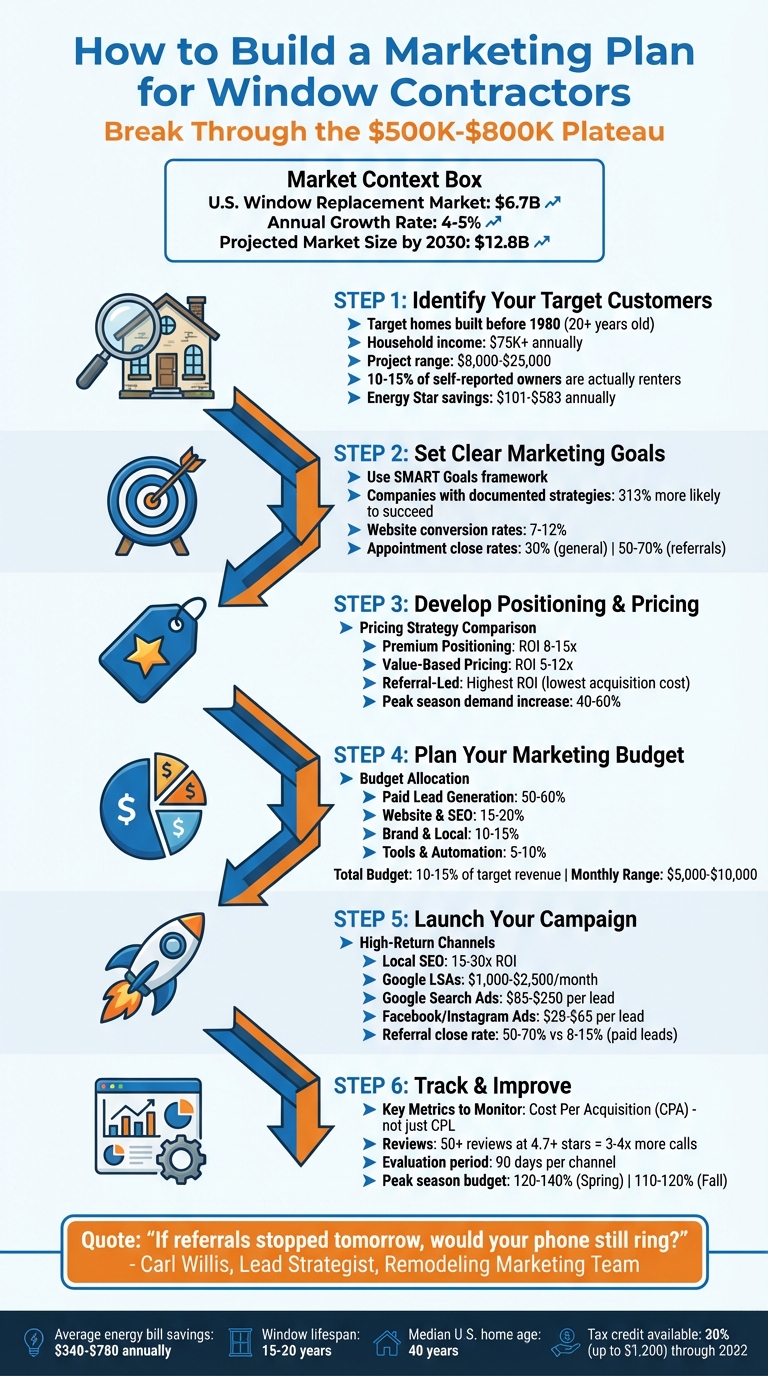
6-Step Marketing Plan Framework for Window Contractors
Step 1: Identify Your Target Customers
Before diving into marketing, it’s crucial to figure out who your ideal customers are. The U.S. window and door market is projected to hit $12.8 billion by 2030, but not every homeowner is a good match for your services. Trying to appeal to everyone often leads to wasted marketing dollars on leads that don’t convert. Pinpointing your ideal customer is the foundation for everything that follows.
Understand Homeowner Demographics
The best prospects for window replacements are homeowners with properties built before 1980 or at least 20 years old (constructed before 2005). Why? Windows generally last 15 to 30 years, and with the median U.S. home being about 40 years old, many homes are due for upgrades. Focus on households earning $75K or more annually, as they’re more likely to afford projects that typically range from $8,000 to $25,000.
For targeted outreach like direct mail or door-to-door canvassing, prioritize neighborhoods with homes built before 1995. These areas often have the highest concentration of aging, failing windows.
Once you’ve identified your audience, think about the specific problems they’re dealing with.
Pinpoint Customer Pain Points
Homeowners usually contact contractors when they’re dealing with issues like condensation, drafts, or windows that don’t open or close properly – problems that also drive up their utility bills. Households spending $300 to $500 monthly on heating and cooling are strong candidates for upgrades, as Energy Star-certified windows can save them $101–$583 annually.
Recent homebuyers are another high-intent group. They often consider upgrades shortly after moving in. On top of that, the Inflation Reduction Act offers a 30% tax credit (up to $1,200) for energy-efficient windows through 2032, giving homeowners even more incentive to act now.
Conduct a SWOT Analysis
A SWOT analysis can help you figure out how your business stacks up against competitors. Start by listing your Strengths – for example, experienced crews, a 4.7+ Google rating, or partnerships with premium suppliers like Vinyl Windows Co. Then, identify Weaknesses, such as a limited online presence or slow lead follow-up.
Next, look for Opportunities. Are there underserved zip codes where competitors lack Google Guaranteed badges? Is there rising demand due to higher local energy costs? Finally, don’t overlook Threats, like economic downturns that reduce spending on big-ticket items or new low-cost competitors entering your market.
Analyze 3 to 5 direct competitors to uncover areas where they fall short. Maybe their customer service ratings are low, or they don’t offer financing options. Use this insight to position your business where demand is high, but competition is weak. Businesses with documented marketing strategies are 313% more likely to succeed than those that operate without a clear plan.
sbb-itb-a4eb837
Step 2: Set Clear Marketing Goals
Once you’ve defined your audience, the next step is setting goals that are specific and measurable. Broad objectives like “get more leads” or “improve customer experience” won’t provide the direction your team needs. Instead, focus on clear targets that can be tracked and acted upon. Companies with well-documented marketing strategies are 313% more likely to meet their goals.
Use SMART Goals
The SMART framework is a reliable way to create actionable objectives:
- Specific: Clearly define what you want to achieve. For example, instead of saying “increase leads”, aim for something like “generate 50 exclusive leads per month by Q3 2026.”
- Measurable: Quantify your goals. This could mean tracking conversion rates, cost per acquisition, or lead volume.
- Achievable: Make sure your goals align with your resources. A small team might find a target of 120 leads per month unrealistic.
- Relevant: Connect your goals to your business priorities, such as growing annual revenue to $2M or beyond.
- Time-bound: Set a deadline to create urgency and accountability.
Here are some SMART goal examples:
- “Boost monthly Google Profile calls from 30 to 45 by June 30, 2026, by securing 10 new reviews monthly.”
- “Reduce cost per closed job from $800 to $400 by December 31, 2026, by reallocating 60% of ad spend to Google Local Service Ads.”
Tracking metrics like website conversion rates (7–12%) or appointment close rates (30% for general leads and 50–70% for referrals) will help you stay on course.
Once your goals are set, align them with your product’s unique advantages.
Connect Goals to Product Features
SMART goals work best when tied to the strengths of your product. For instance, if you’re promoting Vinyl Windows Co products, emphasize their energy efficiency. A goal might look like this: “Generate 80 qualified leads in Q2 2026 by running Google Ads focused on cutting heating bills by 38%.” Highlighting energy-efficient windows can resonate with homeowners, especially since these products can save them between $340 and $780 annually on energy bills.
Durability is another key selling point. Windows typically last 15–20 years, so the focus should be on acquiring new customers rather than depending on repeat business. Build authority by setting goals like: “Achieve 50+ Google reviews with a 4.7+ star rating by August 2026.” Businesses that hit this benchmark often see 3–4x more calls from local search. Additionally, during high-demand seasons like spring and fall, adjust your lead targets to reflect increased homeowner interest – aim for a 40–60% boost in leads during these periods.
Step 3: Develop Your Positioning and Pricing
It’s time to define your market position in a $6.7 billion industry that’s growing at a steady 4–5% annually. Positioning isn’t about undercutting competitors on price – it’s about showing homeowners why your service stands out as the best choice for an investment ranging from $8,000 to $15,000.
Emphasize Your Unique Selling Points
To stand out, focus on what makes your service different. Start by analyzing 3–5 local competitors to uncover weaknesses in their offerings. Are they falling short in customer service? Do they lack energy-efficient options or meaningful community involvement? Identifying these gaps allows you to align your strengths with homeowner concerns like drafty spaces, high energy costs, or poor soundproofing.
For example, highlight features like advanced weather sealing technology and a lifetime warranty – just as Vinyl Windows Co does in their marketing. Be specific with your claims: mentioning that upgrades can reduce heating bills by 38% carries much more weight than vague promises. Additionally, using real before-and-after photos from local installations can boost conversion rates by 40–60% compared to generic stock images.
Your value proposition should be clear and impactful. Consider this example: “We install energy-efficient vinyl windows with a lifetime warranty, helping homeowners in [Your City] save $340–$780 annually on utility bills”. This approach combines product quality, a local connection, and measurable financial benefits – all crucial factors when 78% of homeowners start their search on Google.
These unique advantages not only set you apart but also lay the groundwork for a pricing strategy that reflects the quality of your service.
Choose Your Pricing Strategy
Your standout features pave the way for a pricing strategy that reinforces your premium position. In the world of window replacement, trust often outweighs price. Competing purely on cost can lead to low close rates (just 8–15%) and razor-thin profit margins. Instead, consider these pricing approaches:
| Strategy | Focus | Best For | Typical ROI |
|---|---|---|---|
| Premium Positioning | Emphasize high-end features and warranties | Affluent neighborhoods and high-value homes | High (8–15x) |
| Value-Based Pricing | Highlight energy savings, financing, and trust | Middle-income homeowners, first-time buyers | Medium (5–12x) |
| Referral-Led | Offer word-of-mouth incentives ($200–$500 per closed job) | All segments through strong social proof | Highest (low acquisition cost) |
Pair your pricing with flexible financing options and highlight the long-term savings. For instance, a homeowner investing $12,000 in energy-efficient windows can recover that cost through energy savings over 15–20 years. If you’re part of the Vinyl Windows Co dealer program, don’t forget to leverage the product training and marketing support they provide. This positions you as an expert, not just another installer.
During peak seasons like March–May and September–November, adjust your pricing to take advantage of the 40–60% surge in demand. Consider offering neighborhood discounts, as similarly aged homes often upgrade around the same time.
Step 4: Plan Your Marketing Budget
Once you’ve nailed down your strategic positioning, it’s time to map out a budget that supports impactful marketing efforts. For home service companies, digital marketing budgets typically range between $5,000 and $10,000 per month. If you’re earning less than $500,000 annually and aiming to grow, allocate 10–15% of your target revenue – not your current revenue – toward marketing. For example, if your goal is to hit $1 million in revenue, setting aside $80,000 to $120,000 annually (or 8–12%) can help you close the gap and reach that target.
Think ahead. The Pipeline Research Team puts it bluntly:
“A contractor spending 3% on marketing in a market where competitors spend 8–12% is bringing a garden hose to a structure fire”.
Private equity-backed companies are entering local markets with aggressive spending, driving up lead costs by over 10% year-over-year. To stay competitive, you need to focus your investment on channels that deliver measurable results. The next step is identifying which channels bring the best return for your business.
Focus on High-Return Channels
Not all marketing channels deliver the same value. Local SEO stands out with the highest long-term ROI, offering returns of 15–30x. Once your site ranks, the cost of acquiring leads drops to $0 in marginal ad spend. Combine this with Google Local Service Ads (LSAs), where you only pay for direct customer interactions – calls or messages – and benefit from the trust-building “Google Guaranteed” badge. Plan to spend $1,000 to $2,500 monthly on LSAs to attract high-intent homeowners.
For immediate lead flow, Google Search Ads are effective but come with a higher price tag – expect to pay $85 to $250 per lead. To balance costs, consider Facebook and Instagram Ads, which target the 92% of homeowners who aren’t actively searching for services. These platforms generate leads at a lower cost, averaging $28 to $65 per lead, making them excellent for demand generation. Dedicate 25–35% of your social budget to retargeting website visitors, as these leads are 40–60% cheaper than cold outreach.
Referral programs are another smart move. Leads from referrals close at much higher rates – 50–70% compared to the 8–15% close rates from platforms like Angi or HomeAdvisor. Offering incentives, such as $200 to $500 per closed job, encourages word-of-mouth recommendations and keeps acquisition costs low. You can also tap into Vinyl Windows Co’s dealer program for added marketing support to strengthen your expert reputation.
Once you’ve identified your channels, it’s time to allocate your budget across campaigns to ensure balance and efficiency.
Divide Your Budget by Campaign Type
A well-structured budget spreads spending across key categories:
| Category | % of Budget | What It Includes |
|---|---|---|
| Paid Lead Generation | 50–60% | Google Ads, LSAs, Facebook Ads |
| Website & SEO | 15–20% | Local SEO, Google Business Profile, content updates |
| Brand & Local | 10–15% | Review generation, referral programs, vehicle wraps |
| Tools & Automation | 5–10% | CRM, email marketing, call tracking |
This breakdown ensures you’re capturing demand through paid ads, building long-term visibility with SEO, and fostering trust through reviews and referrals. During peak seasons – March through May and September through November – consider boosting your ad spend by 25–40% to take advantage of increased homeowner interest. Start ramping up your campaigns 4–6 weeks before these busy periods to ensure your pipeline is ready.
One golden rule: Give each new channel at least 90 days before evaluating its performance. Marketing algorithms need time to optimize, and you’ll need sufficient data to make informed decisions.
“Marketing has lag time. Plant seeds before you need shade. By the time you’re desperate for leads, you’ve already lost two months”.
Patience and consistency go a long way – far more than constantly jumping between strategies.
Step 5: Launch Your Marketing Campaign
With your budget in place and channels chosen, it’s time to roll out campaigns designed to turn homeowners into paying customers. Timing is everything – coordinate your promotions to align with seasonal trends and equip your sales team with the tools they need to close deals efficiently.
Plan Seasonal Promotions
Window replacement demand tends to follow a predictable seasonal rhythm. Homeowners often notice drafty windows in February and March when heating bills spike, and again in August and September as air conditioning costs soar. Use these moments to your advantage by scheduling direct mail postcards to hit mailboxes during these periods.
For digital campaigns, adjust your messaging to match the season. On Google Search Ads, highlight “drafty windows” and heating savings in the fall, while emphasizing energy efficiency in the spring. On Facebook and Instagram, target homeowners in houses built between 1985 and 2010 – these properties are more likely to have aging windows nearing the end of their lifespan.
To boost local visibility, leave door hangers on 20–30 neighboring homes after completing an installation. A simple message like “Your neighbor just upgraded their windows” can spark interest and drive inquiries.
With your seasonal strategies in place, make sure your sales team is ready to handle the influx of leads.
Support Your Dealers
If you’re working with dealers or a sales team, quick lead response is critical. Responding to leads within five minutes can increase conversion rates by up to eight times. Automated text alerts can help ensure sales reps are notified immediately when a homeowner reaches out.
Tap into resources like those offered by Vinyl Windows Co’s dealer program to give your team a competitive edge. Share data that helps close deals, such as the potential for homeowners to save $340 to $780 annually on utility bills after upgrading to energy-efficient windows. Pair this data with professional project photos and certifications to build trust, especially for high-value purchases. Vinyl Windows Co also offers product training and co-marketing materials, which can enhance your team’s expertise and credibility.
Another way to expand your reach is by building referral partnerships with realtors, home inspectors, and energy auditors. These professionals can recommend your services when they identify aging windows in homes. Offering a referral fee of $200 to $500 per closed job can motivate these partnerships. Referral leads often close at rates between 50% and 70%, far outperforming the typical 8–15% close rate for shared leads. This approach adds another layer to your marketing strategy, ensuring a well-rounded, diversified plan.
Step 6: Track Results and Improve
You’ve launched your campaigns, but the work doesn’t stop there. The next step is all about tracking performance and making adjustments to ensure your marketing efforts stay on the right track. Measuring results is what sets thriving contractors apart from those guessing where their budget should go next.
Choose Your Key Performance Indicators
Focus on Cost Per Acquisition (CPA) rather than just Cost Per Lead (CPL). Why? Because a $200 lead with a 45% close rate is far more profitable than an $80 lead that never converts. Tools like CallRail or WhatConverts (priced between $45 and $100 per month) can help you pinpoint which marketing channel – whether it’s Google Local Service Ads, Facebook, direct mail, or referrals – is driving each closed deal.
Don’t overlook review metrics, either. Companies with 50+ Google reviews and a 4.7+ star rating generate 3 to 4 times more calls from their Google Business Profile compared to those with only 10 to 15 reviews. Platforms like Podium or Birdeye ($100 to $300 per month) can automate review requests via text after each installation, helping you build credibility and attract more leads.
| Marketing Channel | Primary KPI | ROI | Timeframe |
|---|---|---|---|
| Google Local Service Ads | Cost Per Lead | 8–15x | 48–72 hours |
| Google Search Ads | Conversion Rate/ROAS | 5–12x | 1–2 weeks |
| Facebook Ads | Cost Per Acquisition | 6–15x | 3–7 days |
| Local SEO | Organic Traffic Growth | 15–30x | 3–6 months |
| Referral Programs | Close Rate | 15–25x | 2–4 weeks |
| Direct Mail | Response Rate | 5–12x | 1–2 weeks |
Analyze and Adjust Your Campaigns
Once you’ve identified your KPIs, use them to fine-tune your campaigns. Allow a 90-day evaluation period for each marketing channel before making major changes. For example, Google Ads needs at least 50 conversions to optimize its bidding algorithms, while SEO efforts often take 4 to 6 months to yield noticeable results.
Adjust your budget based on the season. For peak demand months like Spring (March through May) and Fall (September through November), plan to spend 120–140% and 110–120% of your usual budget, respectively.
Make sure to regularly update negative keyword lists in your PPC campaigns to filter out irrelevant traffic. Exclude terms like “DIY”, “repair”, “car windows”, or “cleaning” to avoid wasting money on low-intent leads. If your Facebook Lead Ads are generating a high volume of low-quality leads, consider switching to landing page conversion campaigns. These require more effort from prospects but tend to attract higher-intent customers.
“If you can’t measure it, you can’t improve it. This final, critical step defines how you will monitor performance and determine success.” – Improvado
Streamline your reporting process to save time and focus on strategy. For example, Signal Theory Inc. cut their reporting time by over 80% – from four hours to just 30 minutes per report – by using Improvado’s automated data pipeline. This freed up their team to focus on campaign adjustments instead of wrestling with spreadsheets, according to Analyst Shayna Tyler.
Companies that document their marketing strategies are 313% more likely to hit their goals. Review your KPIs on a weekly or monthly basis, and don’t hesitate to reallocate your budget from underperforming channels to those delivering the best CPA and return on ad spend.
Conclusion
A well-structured marketing plan is essential for driving growth in the competitive world of window contracting. By taking a step-by-step approach, you can build a strategy that not only attracts leads but also sustains long-term success. Start by focusing on homeowners in older properties valued between $250,000 and $750,000, particularly those who have lived in their homes for 8–15 years. From there, set clear, measurable goals to maintain a steady flow of leads.
Establishing credibility is key. Address common homeowner concerns about costs, materials, and project timelines to build trust. Swap out generic stock images for real project photos – this simple change has been shown to increase conversion rates by 40% to 60%.
Spread your marketing budget across 3 to 5 channels to ensure a balanced and sustainable strategy. High-return options like Google Local Service Ads (LSAs) and Local SEO should be prioritized to reduce over-reliance on any single channel. Roll out campaigns in 90-day phases, starting with LSAs and review generation before branching into search ads and social media. Keep a close eye on your Cost Per Acquisition (CPA) rather than just lead volume, and stick with each channel for at least 90 days before making adjustments.
The foundation of your marketing success lies in offering high-quality products. Partnering with manufacturers like Vinyl Windows Co can give you access to energy-efficient vinyl windows, which reduce heating costs by an average of 38%. Their dealer program provides not only premium products but also training and marketing support, enabling you to justify premium pricing and gain homeowners’ trust for investments ranging from $8,000 to $15,000. This partnership strengthens your reputation and solidifies your position as a premium service provider.
Top-performing contractors consistently demonstrate expertise while simplifying the decision-making process for homeowners. By combining a targeted marketing strategy with the high-quality products and support from Vinyl Windows Co, your business can thrive – even when traditional referral sources slow down.
FAQs
Which 3–5 marketing channels should I start with first?
If you’re in the window contracting business, leveraging the right marketing channels can make all the difference. Here are the top 3–5 strategies to focus on:
- SEO and Organic Search: Make sure your website is optimized so homeowners can easily find you when searching for window services online. A well-optimized site can drive consistent traffic and inquiries.
- Social Media Marketing: Use platforms like Facebook and Instagram to build trust and awareness. Share engaging posts, like before-and-after photos of your projects or tips for maintaining windows, to connect with potential clients.
- Email Marketing: Stay in touch with past clients and nurture new leads through email campaigns. Sending helpful content, special offers, or updates keeps your business top of mind.
- Reviews and Testimonials: Positive feedback from happy customers is a powerful tool. Highlight reviews and testimonials on your website and social media to build credibility and attract more clients.
- Paid Advertising: Invest in targeted ads, such as Google Ads or Facebook Ads, to generate immediate leads in your local area. Paid campaigns can help you reach homeowners actively looking for window services.
By combining these strategies, you can effectively grow your business and connect with more homeowners in need of your services.
How do I figure out my real cost per acquisition (CPA)?
To figure out your actual cost per acquisition (CPA), begin by adding up all your marketing expenses. This includes everything from ad spend to the cost of tools used. Then, divide this total by the number of new customers you acquired during that timeframe. For a clearer picture, consider factoring in indirect costs like labor or overhead. Make it a habit to review your campaign performance regularly – this can help you spot the most cost-efficient strategies and fine-tune your budget.
What should I track in the first 90 days to know it’s working?
In the first 90 days, keep a close eye on key metrics to measure how well your marketing efforts are performing. Pay attention to qualified leads generated, lead volume across different channels, appointment close rates, revenue from new leads, and your overall return on investment (ROI). By consistently reviewing these numbers, you’ll get a clear picture of whether your strategies are helping your window contracting business grow effectively.