When shopping for windows, understanding NFRC ratings is key to choosing energy-efficient options. These labels provide verified data about a window’s performance, including insulation, heat gain, and air leakage. The National Fenestration Rating Council (NFRC) evaluates the entire window assembly – glass, frame, seals, and spacers – ensuring reliable comparisons across products. Here’s what you need to know:
- U-Factor: Measures insulation. Lower values mean better heat retention, ideal for colder climates.
- Solar Heat Gain Coefficient (SHGC): Indicates solar heat allowed through the glass. Lower values help in hot regions; moderate values suit colder areas.
- Visible Transmittance (VT): Shows how much natural light passes through. Higher values mean more light.
- Air Leakage (AL): Rates air passing through seams. Lower values reduce drafts.
- Condensation Resistance (CR): Scores moisture prevention. Higher values help in humid or cold areas.
Windows with NFRC labels meet strict testing standards, often qualifying for ENERGY STAR certification, tax credits, and rebates. By choosing the right ratings for your climate, you can lower energy bills, improve comfort, and meet building codes. Always check the NFRC label to verify a product’s performance.
What NFRC Ratings Are and Why They Matter
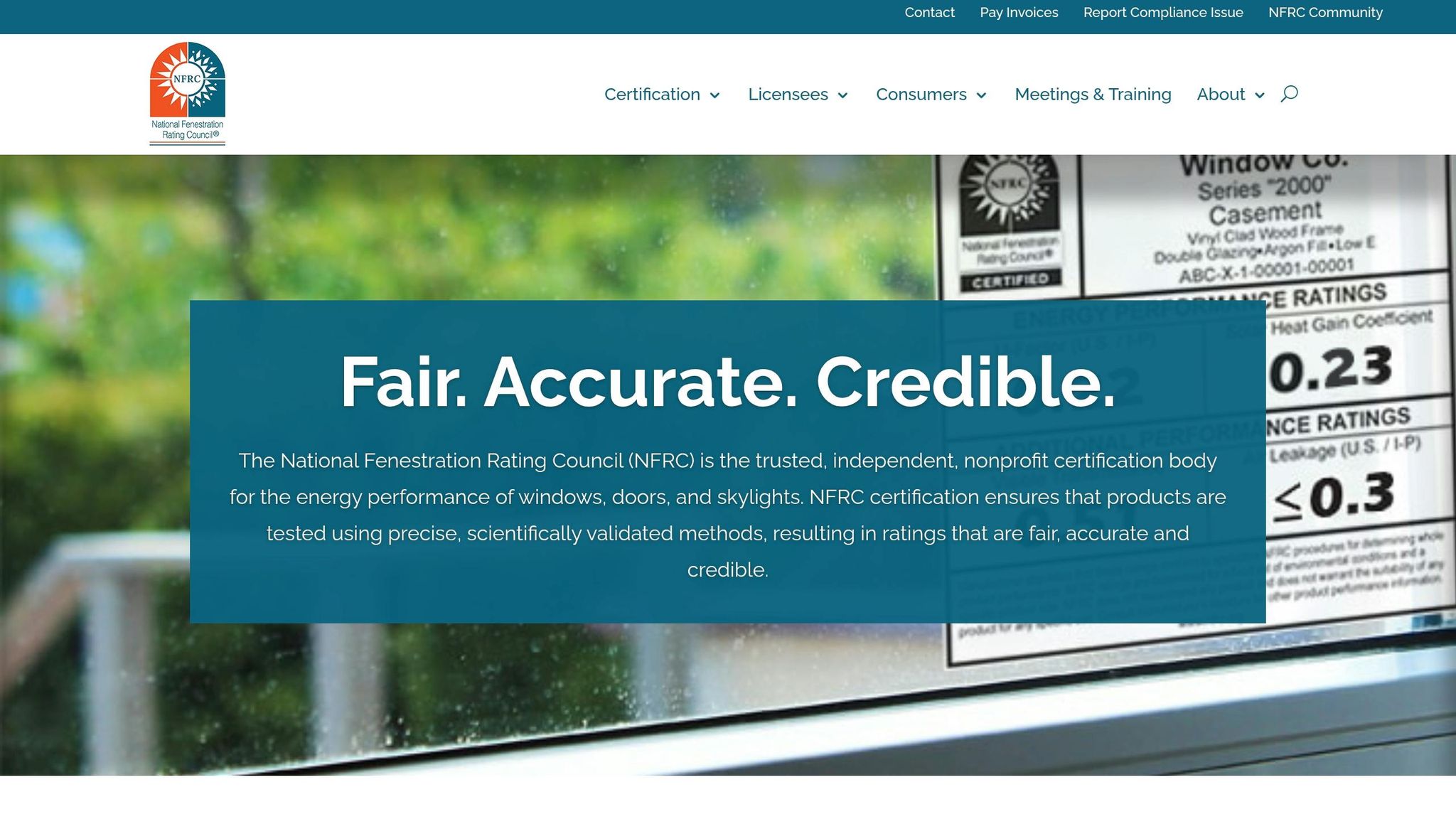
NFRC ratings provide reliable performance data that make it easier to compare windows side-by-side. What sets these ratings apart is that the entire window assembly – from the glass to the frame – is evaluated. This whole-unit approach matters because heat loss doesn’t just happen through the glass; it also escapes through the edges and frame. Before standardized testing began in 1989, manufacturers often shared “center-of-glass” ratings, which ignored the frame’s thermal performance and gave an inflated sense of efficiency.
These ratings are based on rigorous testing that combines computer simulations with physical heat chamber measurements. For certification, the results from these two methods must align within 10%. NFRC certification is essential for meeting building codes like the International Energy Conservation Code (IECC) and California’s Title 24 standards. This robust testing process also forms the foundation for ENERGY STAR collaboration, as explained below.
How NFRC Ratings Work with ENERGY STAR
NFRC plays a key role in certifying ENERGY STAR® products by providing the raw performance data that ENERGY STAR uses to determine efficiency benchmarks. Metrics such as U-Factor (measuring heat transfer) and Solar Heat Gain Coefficient (indicating solar energy allowed through the glass) are tested by NFRC. ENERGY STAR then sets the specific thresholds a window must meet to qualify as energy-efficient for different climate zones.
For instance, under ENERGY STAR Version 7.0 (effective October 23, 2023), windows in the Northern zone require a U-Factor of 0.27 or lower. Additionally, windows with Air Leakage ratings above 0.3 are disqualified from ENERGY STAR certification. To make things easier for consumers, the ENERGY STAR climate zone map is often included on NFRC labels, helping homeowners confirm a product’s regional certification.
Benefits of NFRC-Certified Windows
Having NFRC-certified windows comes with several measurable advantages. For starters, they can cut monthly utility bills by up to 15%, which translates to an average reduction of about 12% in overall energy costs. In regions like the Midwest, where electricity costs average $0.16 per kilowatt-hour and annual bills exceed $1,600, these savings add up quickly.
Beyond saving money, these windows improve comfort by maintaining consistent interior temperatures. They reduce drafts during colder months and minimize temperature differences between the glass and the rest of the room. Windows with higher Condensation Resistance ratings also help keep interior glass surfaces warmer, which can lower the chances of mold or mildew forming.
There’s more: NFRC-certified windows often qualify for federal tax credits and local utility rebates, helping offset upfront costs. They may even allow homeowners to install smaller, more affordable heating and cooling systems, leading to additional savings. Plus, low-e coatings – measured as part of NFRC ratings – block UV rays that can fade furniture, carpets, and artwork, offering long-term protection for your home’s interior.
sbb-itb-a4eb837
The 5 NFRC Rating Categories Explained
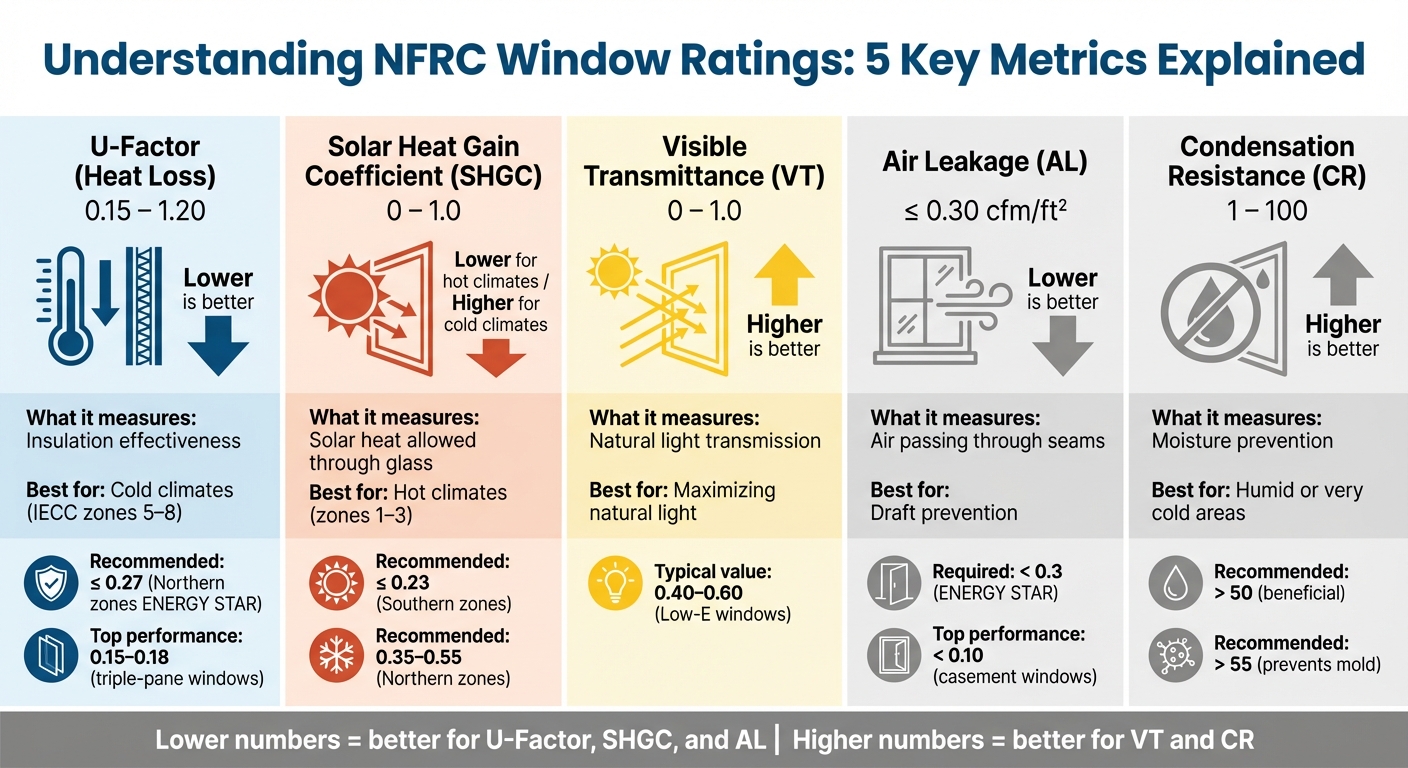
NFRC Window Ratings Guide: Understanding U-Factor, SHGC, VT, AL, and CR Metrics
Grasping the five NFRC metrics allows for an unbiased comparison of windows, helping you evaluate their efficiency. Each metric highlights a specific performance area, from heat retention to moisture resistance.
While three of these ratings – U-Factor, SHGC, and VT – are required on every NFRC label, Air Leakage and Condensation Resistance are optional. Below, you’ll find a breakdown of each metric to guide you in choosing the right windows.
U-Factor: Measuring Heat Loss
The U-Factor evaluates how well a window insulates. Lower values mean better insulation. Most U-Factors range from 0.15 to 1.20, with modern triple-pane windows achieving as low as 0.15–0.18.
“The lower the U-factor, the more energy-efficient the window, door, or skylight.” – Department of Energy
This metric is especially crucial in colder climates (IECC zones 5–8), where retaining heat is essential. ENERGY STAR Version 7.0 requires a U-Factor of 0.27 or lower for Northern zone certification, though a U-Factor of 0.22 or lower is recommended for harsher winters. For most residential buildings in zones 4 through 8, the 2021 International Energy Conservation Code caps the U-Factor at 0.30.
Solar Heat Gain Coefficient (SHGC)
SHGC measures how much solar heat enters through a window, rated on a scale of 0 to 1. Lower SHGC values reduce heat gain, which can cut cooling costs in warmer areas.
“In summer months, a low solar heat gain coefficient helps to keep your home cool. In winter months, a higher solar heat gain coefficient can help to keep your home warm.” – National Fenestration Rating Council
In hot regions (zones 1–3), prioritize a low SHGC; ENERGY STAR Version 7.0 sets the maximum at 0.23. In colder climates, a moderate SHGC (0.35 to 0.55) can help capture winter sunlight for heating. For south- and west-facing walls, lower SHGC values are ideal to prevent overheating in the afternoons.
Visible Transmittance (VT)
VT measures the amount of visible light that passes through a window, rated between 0 and 1. Higher VT values mean more natural light. Low-E double- or triple-pane windows typically have VT values ranging from 0.40 to 0.60.
However, windows with aggressive solar-control coatings that lower SHGC may also reduce VT. To balance natural light and heat, calculate the Light-to-Solar Gain (LSG) ratio by dividing VT by SHGC. A higher LSG ratio indicates better performance in maintaining light while controlling heat.
Air Leakage (AL)
Air Leakage measures how much air passes through window joints and seams, expressed in cubic feet per minute per square foot (cfm/ft²). Lower AL values indicate better sealing against drafts. Many building codes require an AL rating below 0.3 cfm/ft², a standard also necessary for ENERGY STAR certification.
Casement windows often achieve lower AL values – sometimes below 0.10 cfm/ft² – compared to double-hung windows due to their design, which seals on all sides.
Condensation Resistance (CR)
Condensation Resistance scores how well a window prevents moisture from forming on its interior surfaces, rated on a scale from 1 to 100. Higher CR values mean better moisture control. Ratings above 50 are beneficial in humid or cold climates, while scores over 55 help prevent mold and wood damage.
This metric is particularly useful in areas with large temperature differences between indoor and outdoor air. A higher CR rating ensures warmer interior glass surfaces, reducing condensation and its associated risks.
| NFRC Metric | Typical Range | What to Look For | Best For |
|---|---|---|---|
| U-Factor | 0.15 – 1.20 | Lower is better | Cold climates (insulation) |
| SHGC | 0 – 1.0 | Lower (hot) / Higher (cold) | Hot climates (heat blocking) |
| VT | 0 – 1.0 | Higher is better | Natural light preferences |
| Air Leakage | ≤ 0.30 cfm/ft² | Lower is better | Draft prevention |
| Condensation Resistance | 1 – 100 | Higher is better | Humid or very cold areas |
How to Read an NFRC Label
Understanding NFRC labels is essential for comparing windows effectively. These labels follow a standardized format, making it easier to evaluate key performance metrics. The label is split into two main sections: the top row highlights mandatory energy performance ratings – U-Factor, Solar Heat Gain Coefficient (SHGC), and Visible Transmittance (VT) – while the bottom row may include optional ratings like Air Leakage and Condensation Resistance. You’ll also find details like the manufacturer’s name, frame type, and model number in the top section.
Each label features a unique identifier, which you can cross-reference in the NFRC Certified Products Directory (CPD). These ratings provide a comprehensive look at the window’s overall performance.
“If it doesn’t have the label, it isn’t NFRC certified.” – National Fenestration Rating Council
When reviewing labels, keep these guidelines in mind: Lower numbers are better for U-Factor, SHGC, and Air Leakage, while higher numbers are better for VT and Condensation Resistance. For instance, U-Factor values usually range from 0.20 to 1.20, while SHGC and VT are measured on a scale from 0 to 1. Condensation Resistance is scored from 1 to 100. As an example, a window with an SHGC of 0.70 allows 70% of solar heat to pass through.
Many NFRC labels also include an ENERGY STAR map, showing which of the four U.S. climate zones the product is certified for. Look for your region highlighted in blue – if it’s not, the window might not provide optimal energy efficiency for your area. For the Northern zone under ENERGY STAR Version 7.0, windows must have a U-Factor of 0.27 or lower. Similarly, the 2021 International Energy Conservation Code mandates a U-Factor of 0.30 or less for most residential applications in climate zones 4 through 8. These benchmarks help ensure compliance with ENERGY STAR standards and local building codes.
Choosing NFRC Ratings for Your Climate Zone
Now that you know how to read an NFRC label, the next step is to pick window ratings that match your region’s climate. Different zones require different priorities when it comes to window performance.
In colder, heating-focused northern climates (IECC zones 5–8), the main goal is to minimize heat loss. This means choosing windows with a low U-Factor, which helps keep heat inside during those freezing winters. A higher Solar Heat Gain Coefficient (SHGC), ideally between 0.35 and 0.55, can also be beneficial. Why? It allows your windows to take advantage of passive solar heat during the day, giving you a natural boost in warmth.
For southern climates (IECC zones 1–3), where cooling is the main concern, focus on windows with low SHGC values. A SHGC of 0.23 or lower helps reduce the heat entering your home, keeping it cooler and lowering your air conditioning costs. In these areas, the U-Factor is less critical, but it’s still a good idea to aim for values up to 0.40.
For regions in the North-Central and South-Central zones, finding a balance is key. These areas see both cold winters and hot, humid summers, so you’ll need windows with a moderate SHGC and a U-Factor of 0.30 or less. This ensures your windows can handle both heating and cooling needs effectively. To make sure your windows meet these requirements, check the ENERGY STAR climate zone map on the label.
Here’s a quick guide to recommended ratings by climate zone:
| Climate Zone | Recommended U-Factor | Recommended SHGC | Primary Performance Focus |
|---|---|---|---|
| Northern | ≤ 0.27 – 0.30 | 0.35 – 0.55 | Heat Retention / Passive Solar Gain |
| North-Central | ≤ 0.30 | Balanced (Medium) | Balanced Heating & Cooling |
| South-Central | ≤ 0.30 | ≤ 0.23 – 0.25 | Heat Blockage & Draft Sealing |
| Southern | ≤ 0.40 | ≤ 0.23 | Solar Heat Gain Reduction |
Given that inefficient windows cost U.S. homeowners $40 billion annually, matching your window ratings to your climate isn’t just about comfort – it’s also a smart financial decision.
If you’re looking for NFRC-certified options, Vinyl Windows Co (https://vinylwindowsco.com) offers high-performance vinyl windows designed for all climate zones. Up next, dive into the NFRC testing and certification process to learn how these ratings are determined.
The NFRC Testing and Certification Process
Let’s dive into how the NFRC ensures its ratings are reliable and trustworthy. The process is built on rigorous testing and third-party verification, ensuring that every certified product meets high-performance standards.
It all begins when manufacturers send their product data to NFRC-accredited simulation laboratories. These labs use specialized software, THERM and WINDOW, developed by the Lawrence Berkeley National Laboratory, to simulate thermal performance. What’s unique here is the focus on “whole-window” performance – this means evaluating not just the glass but also the frame and seals. For instance, the U-factor is calculated using NFRC 100-2020 standards. This method takes an area-weighted average, factoring in the center-of-glass, edge-of-glass, and frame components. Why does this matter? Because in the real world, heat transfer isn’t just about the glass – frames, spacers, and seals play a big role too.
After the simulation phase, Licensed Inspection Agencies (IAs) step in to verify results and audit production. These independent agencies perform regular factory inspections to ensure that the windows being produced are identical to those tested. This extra layer of scrutiny is why homeowners can trust NFRC-certified data. Once the IAs approve, the product earns its certified label. Every certified product is then added to the Certified Products Directory (CPD), complete with a unique identifier. This makes it easy for inspectors and homeowners to confirm a product’s certification status.
“The National Fenestration Rating Council is an independent nonprofit organization that provides independent ratings and certification of fenestration performance based on ANSI-accredited standards.” – Stephen Aki, Member of the NFRC and FGIA
NFRC’s certification process is also tied to ENERGY STAR requirements. For example, products must meet strict criteria, such as having an Air Leakage rating of 0.3 or lower, to qualify for ENERGY STAR certification. Additionally, NFRC labels are the go-to tool for building inspectors to verify compliance with local energy codes.
Conclusion
NFRC ratings make it easier to select energy-efficient replacement windows by providing third-party verified data. Unlike marketing claims, these ratings evaluate the entire window assembly – frame, glass, spacers, and seals – giving you a clear picture of how the window will perform in real-world conditions, not just in ideal scenarios.
No matter where you live, whether in a colder northern area or a warmer southern climate, NFRC ratings help you focus on what’s most important for your home. Be sure to check the NFRC label and CPD identifier before purchasing to confirm the ratings and ensure compliance with energy codes. Plus, NFRC-certified windows can qualify for ENERGY STAR recognition, along with potential tax credits or rebates.
At Vinyl Windows Co (https://vinylwindowsco.com), we design our windows to meet these stringent NFRC standards, ensuring top-notch energy efficiency, performance, and quality. Armed with this information, you can confidently compare options, meet energy code requirements, and select windows that deliver measurable results.
FAQs
Which NFRC ratings matter most for my home’s climate zone?
When selecting windows for your home, two key NFRC ratings to focus on are U-Factor and Solar Heat Gain Coefficient (SHGC).
- U-Factor indicates how effectively a window prevents heat from escaping, which is especially important in colder climates.
- SHGC, on the other hand, measures how much solar heat passes through the window, a crucial factor for managing indoor temperatures in warmer regions.
These ratings make it easier to pick energy-efficient windows that suit the demands of your specific climate zone.
How can I verify a window’s NFRC label is legitimate in the CPD?
To ensure an NFRC label is authentic within the CPD, start by checking that the window features an official NFRC label displaying certified performance ratings. Next, cross-reference the label’s details with the product information in the NFRC’s official directory. This step confirms that the ratings were determined through verified scientific testing methods.
What’s a good way to balance natural light (VT) with heat control (SHGC)?
To get the best balance between natural light and heat control, pay attention to NFRC ratings. Here’s what they mean:
- Visible Transmittance (VT): This tells you how much daylight passes through the window.
- Solar Heat Gain Coefficient (SHGC): This measures the amount of solar heat the window allows inside.
If you live in a warm climate, go for windows with a higher VT (to let in more light) and a lower SHGC (to block excess heat). For cooler areas, a moderate SHGC combined with higher VT can help maintain comfort and energy efficiency. These ratings are key to keeping your home comfortable and your energy bills in check all year long.