

NFRC ratings make it easier to compare window energy performance. These labels provide standardized metrics for heat loss, solar heat gain, daylight, and more, helping you choose windows that suit your climate and reduce energy costs. Here’s what you need to know:
- U-Factor: Measures heat loss; lower values mean better insulation. Ideal for colder regions.
- Solar Heat Gain Coefficient (SHGC): Controls solar heat; lower values are better for warmer climates.
- Visible Transmittance (VT): Indicates natural light levels; higher values mean more daylight.
- Air Leakage (AL): Measures air drafts; lower values ensure better sealing.
- Condensation Resistance (CR): Rates resistance to moisture buildup; higher scores are better for humid or cold areas.
Always check the whole-window rating on the NFRC label, not just the glass performance. Verify the label in the NFRC Certified Products Directory to ensure compliance with energy codes and optimal performance for your region.
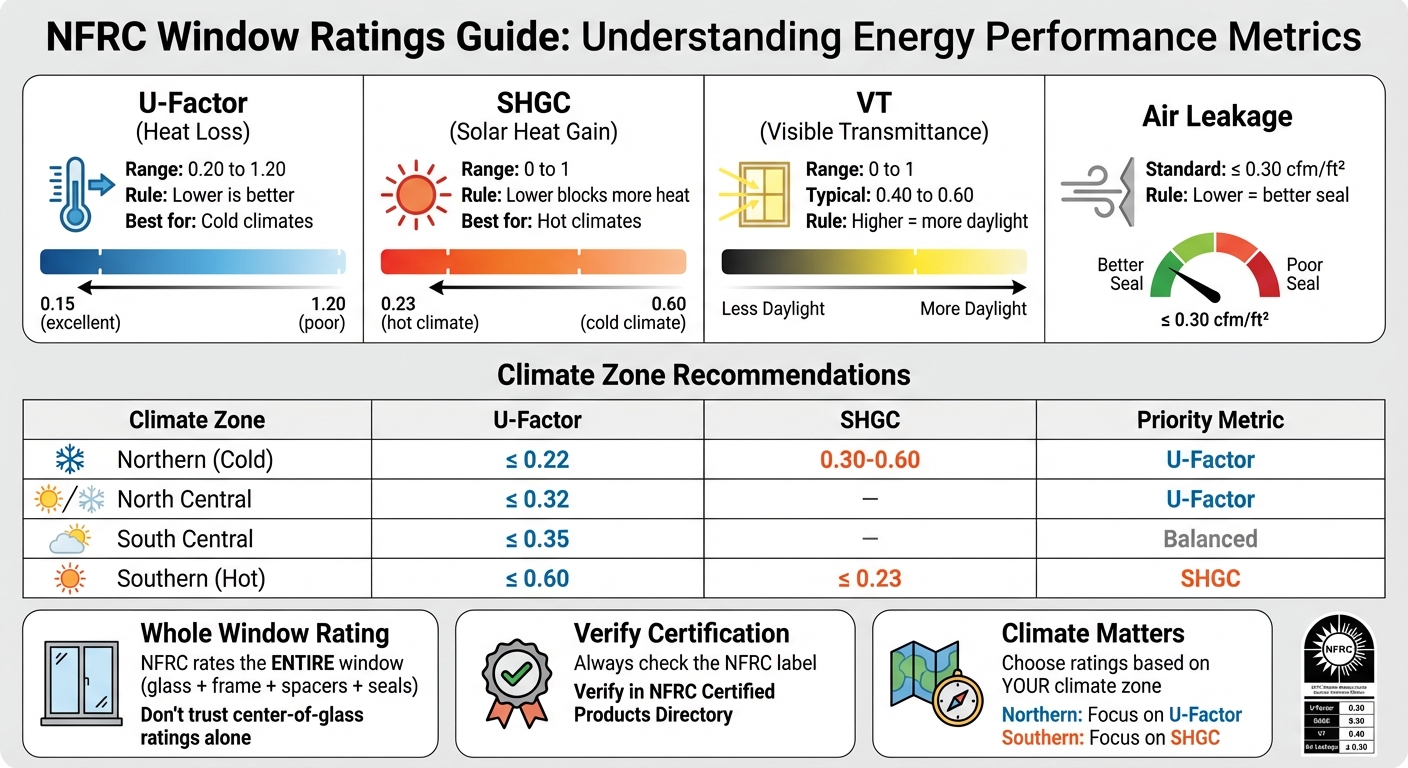
NFRC Window Ratings Guide by Climate Zone
Main NFRC Performance Metrics for Vinyl Windows

The NFRC label on a window provides key details about its performance, helping you understand how it will function in your home and climate.
U-Factor: Heat Loss Through Windows
The U-Factor indicates how much heat escapes through the entire window assembly, including the glass, frame, spacers, and seals. It typically ranges from 0.20 to 1.20, though some high-efficiency windows can go as low as 0.15.
The lower the U-Factor, the better the insulation. For example, a window with a U-Factor of 0.27 loses significantly less heat compared to one rated at 0.50, which can directly impact heating expenses.
"U-factor measures the heat from INSIDE a room that can escape. The lower the number the lower the potential for wasted heating expenses." – NT Window
Your climate zone determines the ideal U-Factor for your windows. According to the 2021 International Energy Conservation Code, the maximum U-Factor allowed for most residential windows in climate zones 4 through 8 is 0.30. For ENERGY STAR Version 7.0 certification, windows in the Northern zone must meet a U-Factor of 0.27 or lower.
Be cautious about "center-of-glass" U-Factors often highlighted in marketing materials. These figures ignore the frame’s thermal performance, making them unsuitable for code compliance. Always verify the whole-window U-Factor on the NFRC label.
For better insulation, vinyl frames with foam filling or thermal breaks can lower the U-Factor. Triple-pane windows with insulated glass units can achieve U-Factors in the 0.15–0.18 range, making them a strong choice for colder climates.
| Climate Zone | Recommended U-Factor |
|---|---|
| Northern | ≤ 0.30 |
| North Central | ≤ 0.32 |
| South Central | ≤ 0.35 |
| Southern | ≤ 0.60 |
Next, let’s look at how solar heat affects indoor comfort.
Solar Heat Gain Coefficient (SHGC): Controlling Solar Heat
SHGC measures how much solar heat enters your home through the windows. It’s rated on a scale from 0 to 1, where a value of 0.40 means that 40% of the available solar heat passes through the window.
Lower SHGC values block more solar heat, which is especially important in warmer climates where air conditioning costs are a concern. In southern regions, an SHGC under 0.30 is recommended for optimal efficiency. For the hottest areas, ENERGY STAR Version 7.0 sets a maximum SHGC of 0.23.
In colder climates, a higher SHGC (between 0.30 and 0.60) can help capture solar heat during winter, reducing heating costs by taking advantage of passive solar gain.
"In the Mid-Atlantic, a low SHGC is the most important consideration for reduction of summer home cooling costs." – Eric Gans, Building Analyst, Hometrust Remodeling
Window placement also matters. South- and west-facing walls in hot climates experience the most intense afternoon sun, so prioritize windows with the lowest SHGC ratings for these areas.
Once you’ve controlled solar heat, the next factor to consider is natural light.
Visible Transmittance (VT): Daylight Through Windows
VT measures how much visible light passes through a window, expressed as a value between 0 and 1. Higher VT values mean more natural light enters your home, which can help reduce the need for electric lighting.
Modern Low-E double- or triple-pane windows typically have VT ratings between 0.40 and 0.60. This range balances energy efficiency with sufficient daylight.
However, adding solar-control coatings to reduce SHGC can also lower VT, as these coatings block both heat and light. High-performance coatings can still maintain good natural light levels while minimizing heat, but it’s important to verify both VT and SHGC on the NFRC label.
Choose VT based on how you use each room. For example:
- Kitchens and living rooms benefit from higher VT (around 0.60) to maximize daylight.
- Bedrooms or media rooms may need lower VT (around 0.40) to minimize glare.
The Light-to-Solar Gain (LSG) ratio – calculated by dividing VT by SHGC – shows how well a window balances daylight and solar heat control. A higher LSG ratio means more light enters without excessive heat, making it a helpful metric for comfort and efficiency.
sbb-itb-a4eb837
Additional NFRC Performance Ratings
Beyond assessing heat loss and solar gain, some NFRC labels provide extra ratings to evaluate a window’s airtightness and resistance to moisture. These optional metrics – Air Leakage and Condensation Resistance – offer added value for homeowners, especially those in areas with harsh climates.
Air Leakage: Draft Protection in Focus
Air Leakage (AL) measures how much air seeps through a window’s assembly, expressed in cubic feet per minute per square foot (cfm/ft²). A lower AL value means the window is better sealed, which helps prevent drafts and saves on heating and cooling costs. The standard for most building codes is an AL rating of 0.3 cfm/ft² or less, and windows must meet this threshold to qualify for the ENERGY STAR label.
"The lower the AL, the less air will pass through cracks in the window assembly."
– Hometrust Remodeling
If you’re worried about drafts or live in an area with severe weather conditions, check the AL rating on the NFRC label or consult the NFRC Certified Products Directory. Choosing a window with an AL significantly below 0.3 cfm/ft² can improve your home’s energy performance.
Now, let’s shift to another critical factor – moisture resistance.
Condensation Resistance: Guarding Against Moisture Damage
Condensation Resistance (CR) is rated on a scale from 1 to 100, with higher scores indicating better resistance to moisture forming on the window’s interior surface. This rating is calculated using thermal modeling software developed by Lawrence Berkeley National Laboratory. CR is particularly important in cold, humid environments where condensation can lead to mold, wood damage, or frame deterioration.
"The higher the CR rating, the better that product is at resisting condensation formation."
– Hometrust Remodeling
Because CR ratings are optional, not all manufacturers include them on NFRC labels. If you live in a cold or humid region, seek out windows with high CR values to safeguard your home’s interior and maintain healthier indoor air quality.
Vinyl Windows Co ensures its products come with detailed NFRC labels, helping you choose windows that align with your energy and comfort needs.
Common Misunderstandings About NFRC Ratings
Even if you’re familiar with NFRC metrics, it’s easy to misinterpret how they apply when comparing vinyl windows. These misunderstandings can lead to poor purchasing decisions and windows that may not perform well in your specific climate.
NFRC Ratings Measure the Complete Window, Not Just Glass
One common mistake is assuming NFRC ratings only evaluate the glass. In reality, they assess the entire window assembly – this includes the vinyl frame, spacers, and seals. Why does this matter? Because components like frames and spacers often conduct more heat than the glass itself. Some marketing materials may focus on center-of-glass (COG) U-factors, which ignore heat loss through other parts of the window. However, building codes require whole-window ratings for compliance.
"A window with high-performance glass in a thermally poor frame may carry a weaker overall rating than the glass specification alone would suggest."
– Window Installation Authority
For vinyl windows, this comprehensive evaluation ensures the insulating properties of the frame and energy-efficient glass packages are accurately captured in the overall energy efficiency score. Always check the whole-window rating on the NFRC label – it’s the best indicator of a window’s actual performance.
This holistic approach is what makes NFRC ratings reliable and helps ensure windows meet the demands of different climates.
Always Verify NFRC Labels Instead of Relying on Claims
Never take marketing claims at face value. Always verify window performance using the NFRC label and its unique product identifier in the Certified Product Directory (CPD).
"If it doesn’t have the label, it isn’t NFRC certified."
– National Fenestration Rating Council
Windows without NFRC certification are often assigned default U-factor and SHGC values by building codes. These default values are intentionally conservative, signaling lower performance, which can complicate permit approvals. To avoid surprises, confirm the NFRC label and verify its unique ID in the CPD.
Understanding how to read the label ensures you’re choosing windows that align with your region’s climate and energy needs.
Climate Determines Which NFRC Ratings Matter Most
The importance of specific NFRC metrics depends heavily on your local climate. In colder regions like Minnesota, a low U-factor (≤ 0.22) is crucial to minimize heat loss. In hotter areas like Arizona, a low Solar Heat Gain Coefficient (SHGC) (≤ 0.23) is key to reducing cooling costs.
| Climate Priority | Primary Metric | Recommended Value (ENERGY STAR v7.0) |
|---|---|---|
| Northern (Cold) | U-Factor | ≤ 0.22 |
| Southern (Hot) | SHGC | ≤ 0.23 |
| All Regions | Air Leakage | ≤ 0.30 cfm/ft² |
A common pitfall is focusing solely on one metric, like the U-factor, without considering others like SHGC. For instance, in mixed climates, this could lead to overheating problems. Always check the Climate Zone on the NFRC label to ensure the window is designed for your region. A window optimized for hot climates won’t necessarily meet the demands of colder areas.
Vinyl Windows Co simplifies this process by providing detailed NFRC labels on all their products, making it easier to match window performance to your local climate and energy code requirements.
Conclusion
NFRC ratings take the guesswork out of window shopping by letting you compare the performance of the entire window – frames, glass, spacers, and seals – all of which directly affect your heating and cooling costs.
Choose ratings that suit your climate: in colder areas like Minnesota, focus on a low U-Factor (≤ 0.27) to cut down on heat loss. In hotter places like Arizona, go for a low SHGC to lower air conditioning costs – potentially saving up to 12% compared to average energy expenses. These metrics show why verified labels are so important.
Make sure to check the physical NFRC label and consult the Certified Products Directory. Whole-window ratings are also required to meet building code standards.
With these tools in hand, you can confidently pick windows that align with your region’s energy needs. For windows that truly save energy, Vinyl Windows Co offers NFRC-certified, high-performance vinyl windows designed for various climates, complete with detailed labels to help you meet local energy codes effortlessly.
FAQs
How do I find my climate zone for NFRC ratings?
To figure out your climate zone for NFRC ratings, head over to the EPA ENERGY STAR® website. There, you’ll find detailed information about climate zones across the U.S., making it easier to choose energy-efficient windows tailored to your region.
What’s the difference between whole-window and glass-only ratings?
Whole-window NFRC ratings assess the performance of the entire window system, taking into account the frame, spacer, and glazing. On the other hand, glass-only ratings concentrate exclusively on the glass or glazing component. While whole-window ratings offer a broader view of overall energy efficiency, glass-only ratings provide insights specific to the glass itself.
Why isn’t Condensation Resistance (CR) always on the NFRC label?
Condensation Resistance (CR) is not always displayed on the NFRC label. This is because it’s influenced by factors such as the temperature on the room-side surface of the window and the indoor humidity levels. Since NFRC ratings are determined under controlled, fixed conditions, they may not fully represent actual indoor environments. For this reason, CR isn’t consistently included on all labels, even though it plays a role in overall performance.


