

ENERGY STAR 7.0, implemented on October 23, 2023, introduced stricter energy efficiency standards for residential windows, pushing manufacturers toward advanced designs like triple-pane glass and specialized coatings. These updates aim to lower energy costs and reduce greenhouse gas emissions, benefiting homeowners and the environment. Key changes include:
- Tighter U-Factor Requirements: Northern zone now ≤ 0.22, with other zones also seeing reductions.
- New SHGC Standards: Southern and South-Central zones capped at ≤ 0.23, while Northern zone adds a minimum ≥ 0.17.
- Focus on Whole-Unit Performance: Frames, seals, and spacers are now part of compliance testing.
For vinyl windows, this means adopting advanced materials, improving frame designs, and optimizing glass packages. While these updates may increase upfront costs, the long-term energy savings and potential federal tax credits make them a worthwhile investment. Manufacturers like Vinyl Windows Co are already aligning their products and processes to meet these updated benchmarks, ensuring compliance and improved performance.
U-Factor and SHGC Requirements by Climate Zone
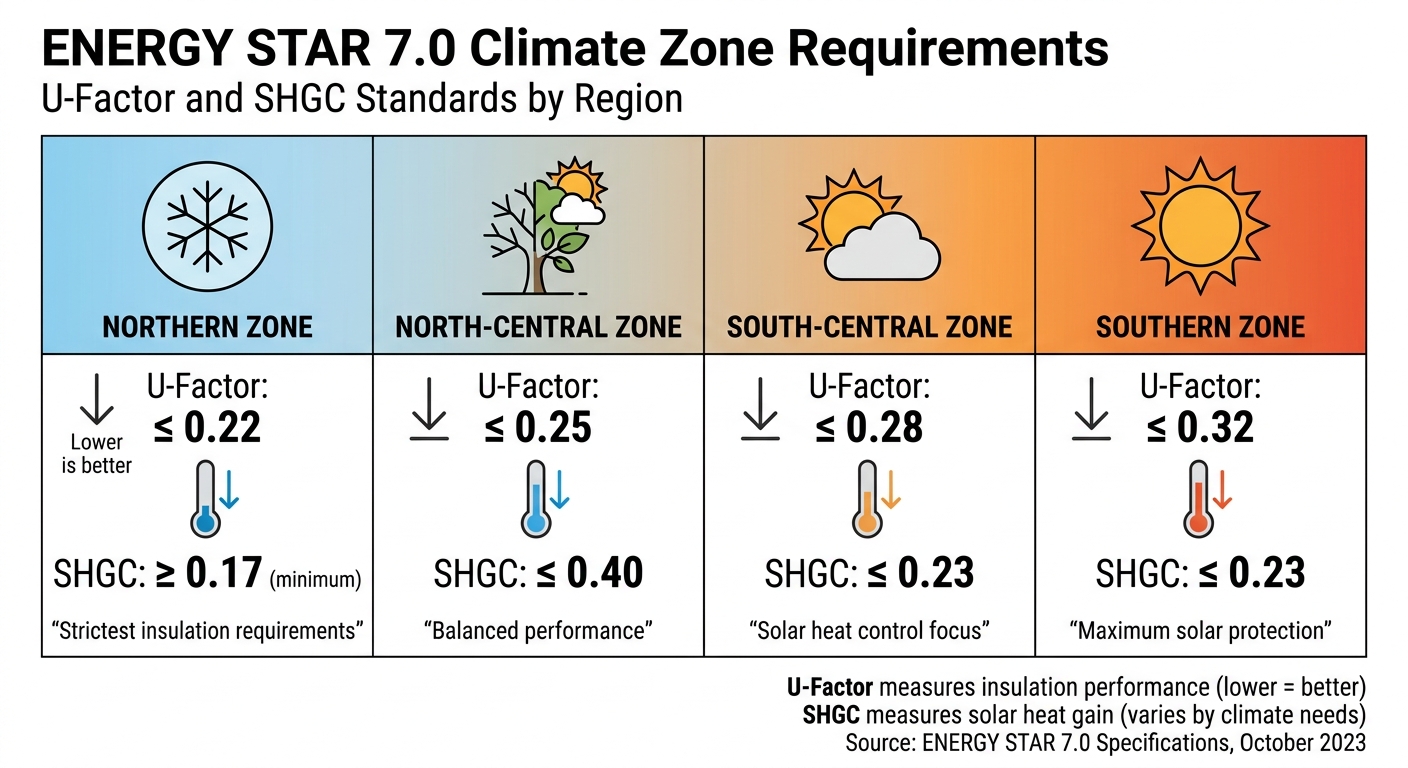
ENERGY STAR 7.0 Climate Zone Requirements for U-Factor and SHGC
Understanding U-Factor and SHGC Standards
U-Factor measures how well a window insulates against heat transfer. A lower U-Factor (as low as 0.20) means better insulation, keeping heat inside during winter and blocking outdoor heat during summer.
Solar Heat Gain Coefficient (SHGC) evaluates how much solar radiation passes through a window. Lower SHGC values reduce heat gain, making them ideal for warmer climates with high cooling costs. In colder areas, higher SHGC values can help capture solar heat for passive warming.
With the release of version 7.0, ENERGY STAR® has introduced stricter standards than ever before. As Andersen Windows highlights:
U-Factor requirements are significantly stricter in ENERGY STAR® version 7.0.
The updated standards set U-Factor limits at ≤ 0.22 for the Northern zone, ≤ 0.25 for North-Central, and ≤ 0.32 for Southern zones. SHGC limits are now capped at ≤ 0.23 for South-Central and Southern regions. Notably, the Northern zone now includes a minimum SHGC requirement of ≥ 0.17, encouraging the use of windows that take advantage of passive solar heating during colder months.
How Climate Zones Affect ENERGY STAR 7.0 Requirements

The U.S. is divided into four climate zones, each with specific performance benchmarks tailored to regional conditions. The table below outlines the updated standards:
| Climate Zone | U-Factor Requirement | SHGC Requirement |
|---|---|---|
| Northern | ≤ 0.22 | ≥ 0.17 |
| North-Central | ≤ 0.25 | ≤ 0.40 |
| South-Central | ≤ 0.28 | ≤ 0.23 |
| Southern | ≤ 0.32 | ≤ 0.23 |
These zone-specific standards ensure windows are optimized for the unique demands of each region.
For homeowners in states like Virginia and North Carolina – typically classified under North-Central and South-Central zones – windows need to meet U-Factor ranges of ≤ 0.25 to ≤ 0.28 and SHGC values between ≤ 0.23 and ≤ 0.40. This balance is crucial for managing the seasonal temperature shifts and humidity challenges common in these areas. These requirements also push manufacturers to innovate in vinyl window design to meet these stricter criteria.
The National Fenestration Rating Council (NFRC) label plays a key role in verifying compliance. Unlike focusing solely on the glass, the NFRC evaluates the entire window assembly, including the frame and spacers. This comprehensive approach ensures that windows meet the evolving demands of ENERGY STAR 7.0 standards while guiding necessary design and production updates.
sbb-itb-a4eb837
Changes to Vinyl Window Design and Glass Packages
Advanced Glass Technologies
With the introduction of ENERGY STAR 7.0, manufacturers have had to rethink their glass options. In colder regions like the Northern climate zone, triple-pane glass has become the go-to choice to meet the tough U-Factor requirement of ≤ 0.22. This marks a shift away from dual-pane glass in these areas.
Meanwhile, in North-Central, South-Central, and Southern zones, dual-pane glass remains viable when paired with specialized Low-E coatings, such as "SmartSun" or "HeatLock" technology. These coatings are designed to filter 40%–70% of solar heat while still allowing natural light to pass through, which is key for meeting the SHGC limits in warmer climates. For example, in the Southern zone, the SHGC requirement has tightened from ≤ 0.25 to ≤ 0.23, making solar control even more critical.
Argon gas fills are now standard across all climate zones, as they help lower conductive heat transfer within the 1/2-inch air space between panes. Triple-pane windows, in particular, offer three surfaces for Low-E coatings (compared to two in dual-pane windows), which can cut energy loss through windows by 30% to 50% – a necessity for meeting the new standards.
Frame and Seal Design Requirements
While advancements in glass technology are crucial, frame and seal designs play an equally important role in overall efficiency. Casement, awning, and picture windows are increasingly favored over double-hung or single-hung styles. Why? These designs either seal more tightly or are fixed, making it easier to meet energy requirements with standard glass packages. For instance, casement and awning windows use compression seals that press firmly against the frame under wind pressure, while picture windows eliminate air leakage altogether by having no moving parts.
Warm-edge spacer technology has also become essential, especially in Northern zones where the U-Factor requirement dropped from ≤ 0.27 to ≤ 0.22. These spacers reduce heat transfer at the edges of the window and help prevent condensation by avoiding direct contact with the glass. Adding grilles, however, can compromise energy efficiency by conducting heat between panes, so some experts recommend skipping grilles altogether or using specialized energy spacers to maintain compliance.
For installations at higher elevations – above 4,000 feet – breather tubes are required to prevent pressure buildup. However, these tubes can increase the U-Factor by allowing air to escape the insulating gap, making it necessary to use superior glass packages to stay compliant.
Manufacturing Changes for ENERGY STAR 7.0 Compliance
Material and Production Updates
To meet the new ENERGY STAR 7.0 standards, manufacturers have restructured their production processes and material sourcing. One of the most notable changes is the shift to triple-pane glass for products in the Northern climate zone, which must now achieve a U-Factor of ≤ 0.22. This transition has required retooling facilities previously optimized for dual-pane systems, as triple-pane glass introduces added weight and complexity. These changes signal a major adjustment for production lines aiming to meet the updated benchmarks.
Another key update is the integration of advanced Low-E coating technologies into production workflows. These coatings, essential for both dual- and triple-pane windows, demand precise application. Triple-pane units, in particular, require specialized equipment to coat three Low-E surfaces and ensure consistent quality.
Manufacturers are also standardizing the use of argon-gas fill systems and "energy spacers" designed to reduce thermal bridging by avoiding direct contact with the glass. To accommodate legacy dual-pane products, some manufacturers are incorporating factory-applied energy performance panels, enabling these older designs to meet ENERGY STAR criteria without fully transitioning to triple-pane production.
Testing and Certification Process
In addition to production changes, manufacturers are now subject to more stringent testing requirements. ENERGY STAR 7.0 certification emphasizes whole-unit performance testing, moving beyond "center-of-glass" measurements. This approach, overseen by the National Fenestration Rating Council (NFRC), evaluates all components – frames, sashes, glass edges, seals, and even optional features like grilles – as a cohesive system. The goal is to ensure consistent performance across all climate zones.
Air leakage testing has gained prominence, with manufacturers measuring air leakage in CFM per square foot to ensure tighter seals. Climate zones now have stricter requirements: for example, the North-Central zone’s U-Factor dropped from ≤ 0.30 to ≤ 0.25, and the Southern zone’s requirement shifted from ≤ 0.40 to ≤ 0.32. Manufacturers must also address unique challenges such as high-elevation installations above 4,000 feet, where breather tubes can raise U-Factors, necessitating higher-performing glass packages to maintain compliance.
"The ENERGY STAR Version 7.0 specification provides a significant jump in efficiency and savings and will recognize a good selection of types and styles of products offered by a variety of manufacturers at a range of price points." – Doug Anderson, Product Manager, ENERGY STAR
Although ENERGY STAR certification is optional, manufacturers seeking it must adhere to NFRC-certified whole-unit ratings rather than relying on component-level data. For those aiming to qualify for federal tax credits, even stricter "Most Efficient" criteria apply, requiring a U-Factor of ≤ 0.20.
Vinyl Windows Co Solutions for ENERGY STAR 7.0
Vinyl Windows Co has embraced the updated ENERGY STAR 7.0 standards by refining its product offerings and dealer support strategies to meet these new criteria effectively.
ENERGY STAR-Compliant Product Line
Vinyl Windows Co has introduced glass packages specifically designed to meet ENERGY STAR 7.0 standards across all climate zones. For the Northern zone, where U-Factor requirements are stringent, the company offers triple-pane glass with dual Low-E coatings and argon gas fills. This combination provides excellent insulation while maintaining the required Solar Heat Gain Coefficient (SHGC) for passive solar heating.
In the North-Central zone, dual-pane units feature advanced Low-E coatings applied to multiple glass surfaces, ensuring energy efficiency tailored to the region’s climate. For the Southern and South-Central zones, Vinyl Windows Co focuses on solar control glass packages that help lower cooling costs while meeting thermal performance standards.
The company’s window designs also emphasize structural efficiency. Options like casement, awning, and picture windows naturally create tighter seals, offering better energy performance compared to traditional hung windows. For homeowners looking to add decorative grilles, Vinyl Windows Co incorporates energy spacers that minimize thermal bridging without compromising the aesthetic appeal.
Additionally, the company supports ENERGY STAR compliance by equipping its dealer network with tools and training to ensure smooth integration of these products into the market.
Support and Training for Dealers
Vinyl Windows Co provides its dealer network with NFRC-certified thermal specifications and climate-specific ordering tools. These resources help dealers select the right products by using whole-unit ratings rather than just center-of-glass data, reducing the risk of compliance errors.
Dealers are also trained to transition from Version 6.0 to 7.0, with a focus on the updated climate zone guidelines. This is especially crucial for regions like California and Nevada, where zone boundaries have shifted. To further assist contractors, Vinyl Windows Co offers marketing materials and customer education tools that highlight the benefits of 7.0-compliant windows. These resources help homeowners understand the long-term value of these windows, including energy savings and enhanced comfort throughout the year.
Conclusion
ENERGY STAR 7.0 introduces the biggest update in window performance standards in over a decade. With stricter U-Factor requirements – dropping to ≤ 0.22 in the Northern zone and ≤ 0.32 in the Southern zone – and a new minimum SHGC requirement for the North, these changes are steering the vinyl window industry toward triple-pane glass, advanced Low‑E coatings, and better frame designs. These advancements aim to improve energy efficiency and homeowner comfort.
Adopting these standards nationwide could lead to $156 billion in annual savings and reduce greenhouse gas emissions by over 53 billion pounds. Additionally, compliance offers access to federal tax credits, which can help offset the higher initial costs.
Vinyl Windows Co has taken steps to support contractors by offering climate-specific glass packages, NFRC‑certified specifications, and training tools. This ensures that ENERGY STAR 7.0–compliant windows are installed with confidence and that customers understand their long-term benefits. These efforts align with the industry’s move toward whole-unit performance ratings, which consider frames, spacers, and seals alongside glass efficiency.
What’s Next for Energy‑Efficient Vinyl Windows
Looking ahead, ENERGY STAR’s criteria provide a preview of future mandatory energy codes. As building codes become more stringent, innovations like triple-pane glass, specialized coatings, and advanced sealing technologies introduced by version 7.0 are expected to become standard features rather than premium upgrades.
The industry is also shifting focus to whole-unit performance ratings, moving away from center-of-glass measurements. This trend encourages manufacturers to design windows that balance thermal efficiency with aesthetic appeal. For homeowners and professionals, staying informed about these evolving standards and choosing products that exceed current requirements will ensure both compliance and long-term performance. The vinyl window industry’s ongoing advancements highlight its dedication to improving energy efficiency and preparing for the next wave of standards.
FAQs
Do I need triple-pane vinyl windows to meet ENERGY STAR 7.0?
Triple-pane vinyl windows are a popular choice for colder climates, as they meet the updated ENERGY STAR 7.0 standards. These windows provide excellent insulation and are designed to achieve the lower U-factor ratings specified in the new guidelines. In milder regions, double-pane windows might still meet the necessary standards, depending on the specific criteria for those areas.
How do I know which ENERGY STAR 7.0 climate zone I’m in?
To find your ENERGY STAR 7.0 climate zone, refer to the updated EPA climate zone map. The map categorizes regions into four zones: Northern, North-Central, South-Central, and Southern. Each zone has specific performance requirements for windows, doors, and skylights. This ensures your selections align with energy efficiency standards tailored to your location.
Will ENERGY STAR 7.0 windows qualify for a federal tax credit?
No, windows installed in 2026 will not be eligible for a federal tax credit. The ENERGY STAR 25C Home Improvement Credit is set to expire on December 31, 2025.


